
Gymnastics fans have taken note to the growing success of Sweden in women’s gymnastics over the past few years. But one byproduct of this recent success is fans often incorrectly interpret the improving results as first time accomplishments in Swedish program history. On one occasion Lauren Hopkins over at The Gymternet had to specifically address that she didn’t “forget” to mention Sweden in her list of programs that achieved their best placement ever at the 2022 World Championships. The truth is, Sweden has already reached many of the most prestigious milestones in the sport.
This brings us to one of the more obscure historical details that is rarely talked about these days in gymnastics fandom. Sweden was once a powerhouse in women’s gymnastics and has done all of the following:
-Gold at the Olympics
-Gold at the World Championships
-Gold in an individual event
-Team Gold at the World Championships
-Multiple 4th place finishes in Olympic Team Finals
-Medal in World Championships All-Around
-Medal in European Championships All-Around
-Medal in Olympic Event Finals
-Gold on multiple apparatuses in Event Finals at the World Championships
-Gold on multiple apparatuses in Event Finals at the European Championships
-Won medals in two different events (Olympics)
-Won medals in four different events (World Championships)
-Won medals in five different events (European Championships)
-Won a medal in every individual event at the European Championships
Then there is the staggering statistic that Swedish gymnast Ann-Sofi Pettersson finished her career with more combined medals at World Championships and Olympics than a number of iconic All-Around Champions including Elena Davydova, Mary Lou Retton, Tatiana Gutsu, Carly Patterson, Gabby Douglas and Sunisa Lee.
Swedish women’s gymnastics was once such a dominant and influential force that the very first time a woman carried the torch in the opening ceremony of an Olympic games, it was a member of the Swedish women’s gymnastics program. Women’s gymnastics was the sport where this major milestone in achieving gender equality at the Olympics was first accomplished and it wasn’t Vera Caslavska or Larissa Latynina, but the Swede Karin Lindberg. She is formally credited as the 8th person ever to be given the honor to serve as an opening ceremony torchbearer, but most significantly had ended the tradition of this role being reserved exclusively for the men.

The story of Karin Lindberg breaking the gender barrier in the opening ceremony has its origins in 1949 when the IOC awarded the 1956 Olympics to Australia. But in order to secure their victory Australian Olympic organizers had either neglected to mention or significantly downplayed the impact their stringent animal quarantine laws would have on the games. This led to a crisis where equestrian could not be held in conjunction with the rest of the 1956 Summer Olympics and was syphoned off into its own separate Olympic Games that would be held in Stockholm, Sweden.
For this reason, many Olympic record books count 1956 as having three separate Olympic Games, one each for Summer, Winter and equestrian. The 1956 Stockholm equestrian Olympic Games would go down as a fluke one-time event, the likes of which has never occurred before or since. But because it was an Olympic event, held in a different country, and at a different time of the year since Sweden and Australia experience the summer season in different months, naturally it was treated as its own separate Olympics including having its own opening ceremony.
As the Olympic hosts Sweden was allowed to select their own athletes for the ceremonial role of carrying the torch and lighting the Olympic cauldron with a special emphasis placed on the role being split between a male and female athlete. But there was one final obstacle, Sweden had a strong men’s equestrian program, but the same could not be said for their women’s program. What Sweden had instead was a powerful women’s gymnastics team and that was what they wanted to showcase instead.
Karin Lindberg had been the top-ranked Swedish gymnast from the last Olympics and this unorthodox chain of events involving horses is how women’s gymnastics became the sport where women were first given official recognition in the IOC torch ceremony. Men’s gymnastics wouldn’t have an athlete participating in the torch ceremony until 48 years later with Greece’s Ioannis Melissanidis at the 2004 Olympics, with the trend then repeating itself at the following Olympic Games in 2008 when China selected both Li Ning and Li Xiaoshuang for the role. As for Karin Lindberg, she remains the first and last gymnast from the women’s side of the sport to do it.
But Lindberg and that era of Swedish gymnastics were more than just torchbearers. Lindberg herself was a 3x Olympian and an Olympic gold medalist. In 1952 she had been the highest scoring member of the Swedish program and if you retroactively applied modern era country limits to the All-Around standings, she would have finished 7th in the Olympic All-Around that year. Lindberg had been the #1 ranked gymnast on vault at the 1948 Olympics but was denied a gold medal because medals in individual events wouldn’t be awarded until the following Olympics.

But it was another Swedish gymnast by the name of Ann-Sofi Pettersson who made history at the 1956 Olympics by winning a bronze medal on vault. It wouldn’t be until the 1984 Olympic boycott that another country from outside the Eastern Bloc managed to win an Olympic medal in an individual event in women’s gymnastics. Sweden also has the distinction of being the only country from neither the Eastern Bloc nor the modern era “Big Four” to win a medal in an individual Olympic event up until the 2004 Olympics. For the entire 20th century Sweden was quite literally its own separate category. In a sport with such a notoriously rigid power structure in the 20th century, no one was able to crack the stranglehold a small number of programs had on the medal count, except for of course, Sweden.
At the 1954 World Championships Swedish gymnasts Ann-Sofi Pettersson (gold) and Evy Berggren (bronze) both won a medal on vault. This meant Sweden had placed multiple gymnasts on the same podium with at least one of them taking gold. The Americans wouldn’t accomplish the same until 1984 with Julianne McNamara and Mary Lou Retton, wouldn’t do so under non-boycott circumstances until 1993 with Shannon Miller and Dominique Dawes, and wouldn’t do so in a non-boycotted full sized Group-1 competition featuring a Team Finals until 2003 (Chellsie Memmel and Hollie Vise).
And when Sweden did so in 1954, they were competing against a full strength Soviet lineup in a time period where not even 3-per country limits had come into existence.
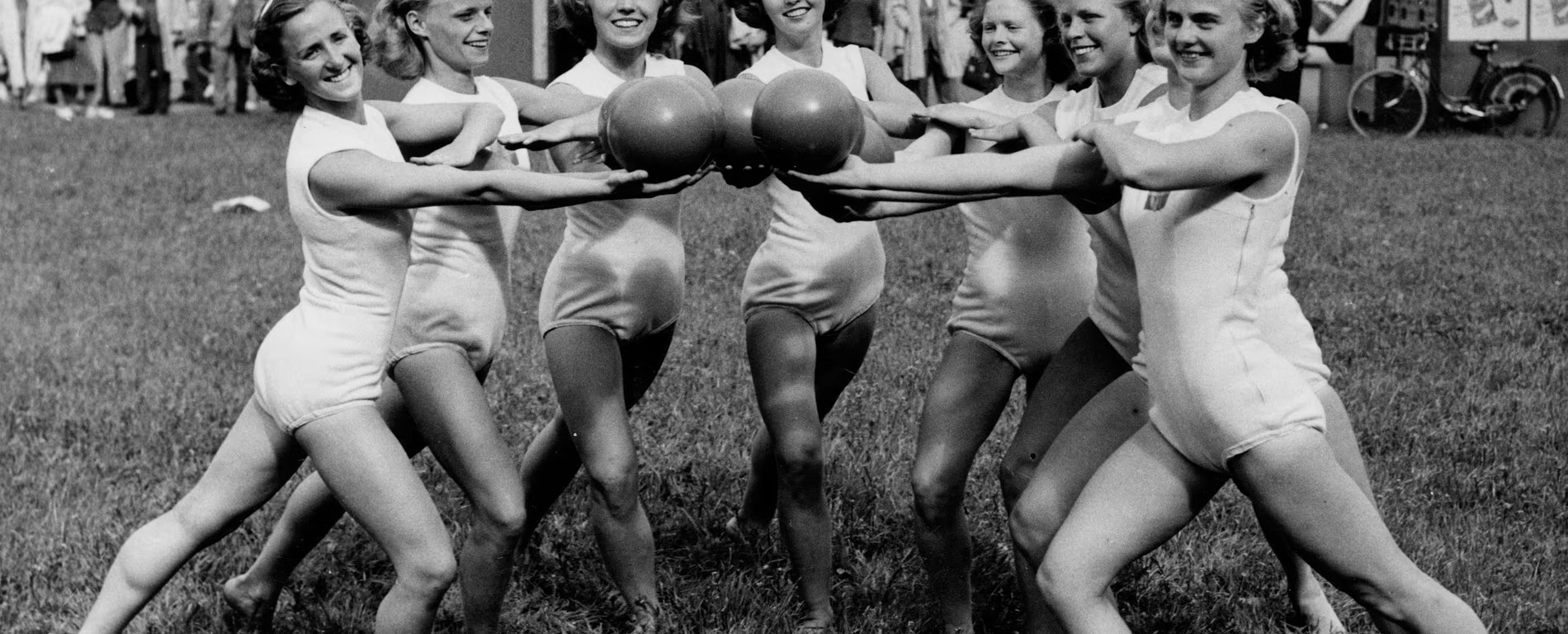
And yet the individual events where Sweden was able to claim some rather extraordinary milestones weren’t even their best events. That seems like a rather ridiculous assertion to make considering Sweden has gold medals on both vault and the uneven bars. But Sweden’s biggest strength was competing in Group Gymnastics during a time period where such events were still contested in women’s artistic gymnastics. The 1952 and 1956 Olympics featured a “7th event” in team portable apparatus that famous gymnasts including Larissa Latynina competed in what was the forerunner to modern rhythmic group gymnastics. This was Sweden’s specialty and they medaled on this event at every Olympics and World Championships it was ever contested in.

What made Swedish gymnastics so significant prior to the 1960s was, Swedish gymnastics.
If that last sentence sounds confusing, it is because there is “Swedish gymnastics” the program, but also “Swedish Gymnastics” a former event within artistic gymnastics that takes its name from Sweden. This is what makes Sweden different from other countries with a rich gymnastics history, for Sweden their legacy goes beyond winning medals. Sweden was one of the originators of the sport.
During the late 1800s and early 1900s as gymnastics was trying to establish itself as an organized sport, three countries with three different styles, interpretations, and visions competed against each other trying to make their version of the sport the dominant form. Along with Germany and Czechoslovakia (Bohemia), Sweden was the third country. For a brief moment “Swedish gymnastics” was an officially sanctioned IOC event that Sweden’s men’s gymnastics team won two gold medals in. These are legitimate medals that are counted towards Sweden’s official medal tally and countries such as Denmark, Belgium, and Norway also have medals in “Swedish gymnastics.”
But Sweden was facing an uphill battle trying to make “Swedish gymnastics” a core gymnastics event in future Olympics. Germany was a far larger and thus significantly more influential country. Not that national influence was the only reason Swedish-style gymnastics faded away. The Germans simply had a more fan-appealing product with their emphasis on athletes competing as individuals.
Sweden had a rich gymnastics tradition which gave them the resources for Olympic success. Sweden didn’t just have a strong women’s program, their men’s program was also winning medals. All of this success was the byproduct of a country where gymnastics tradition ran deep. But times change and with the rise of the Soviets coupled with the sport moving away from the style of gymnastics that Sweden had been a pioneer of, the country found itself on the losing end of change.
The future of gymnastics would be the well-funded programs of the Eastern Bloc, along with countries such as Japan, China, and the United States that all had massive population advantages. Sweden reached the top of the sport right as their window of opportunity seemed to be closing. Sweden has a very noticeable presence in the record book due to its medals from the 1950s that are easy for anyone to accidently stumble across while browsing gymnastics Wikipedia. It feels like a symbolic gesture that the Swedish program wanted to do something to remind people that for 40 years from the 1910s to the 1950s they were a true gymnastics powerhouse.
The 1950 World Championships struggled with a lack of attendance from Eastern Europe making it a rare Group-1 competition that didn’t achieve strong participation rates from the leading powers. Sweden was able to use this competition to prove what they could do under circumstances where they were facing a reduced competitive field. Sweden won gold on three different events including the team competition, along with a silver medal in the All-Around.
Then came the 1963 European Championships where by this point Sweden’s glory days were over, but with the Eastern Bloc once again not in attendance due to a boycott, Sweden was able to showcase its strength one last time against a weakened competitive field. Sweden won a medal on every event, two of which were gold. For Sweden, that was where their story as a gymnastics powerhouse came to an end.
Much has been said about Sweden qualifying into Team Finals at the European Championships for the first time in 2024. But for many of the old powers such as Sweden, Poland, and Hungary, they lack various milestones at the European Championships only because their early 1950s success predates the creation of the women’s European Championships in 1957 and the 1990s-era expansion of a women’s team event. What Sweden accomplished in 2024 was reach one of the few milestones it doesn’t yet have.
Gymnasts such as Emelie Westlund, Nathalie Westlund, Tonya Paulsson, and Jonna Adlertag have undoubtedly brought Sweden to a higher level in recent years. But they aren’t making history for Sweden.
History is returning.

 An Old School Gymnastics Blog