
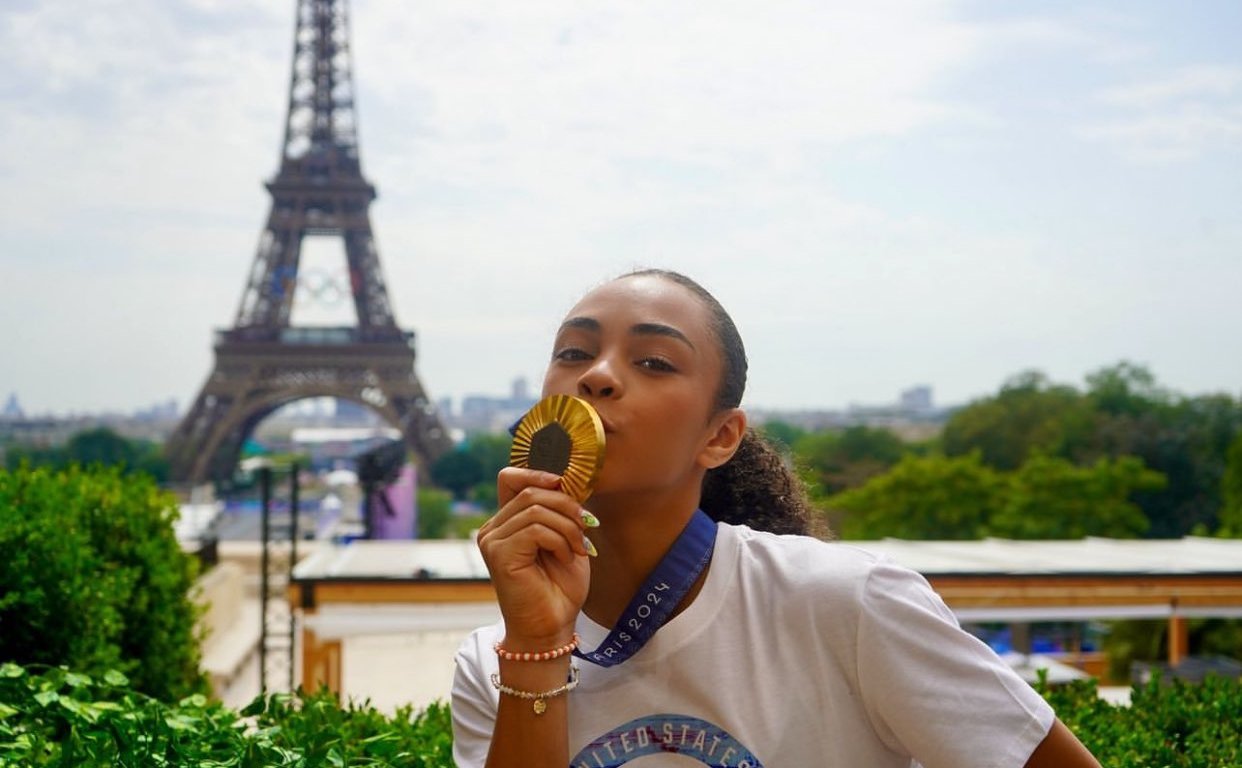
The United States women’s gymnastics team called themselves the “Golden Girls” as a tribute to their status as the oldest American Olympic lineup in recent memory. The Americans did win gold, doing so with their four oldest gymnasts being 21, 23, 24, and 27 years old. But the Americans weren’t even the oldest team to win a medal. That would be Brazil who took bronze while having a lineup where their four oldest gymnasts were 24, 25, 26, and 33 years old.
The All-Around went the same way. When all was said and done, Sunisa Lee, Rebeca Andrade, and Simone Biles were the victors. Giving the Olympics a podium where the average age of the medalists was 24 years old. But in this exact same event something else happened. Germany’s Helen Kevric finished in the #8 position. It was highest placement by a 1st-year senior in 16 years.
Helen Kevric wasn’t the only youngster competing All-Around at the 2024 Olympics. Gymnasts who were from the two youngest age groups, 1st-year seniors and 2nd-year seniors represented 25% of the entire 2024 All-Around field. At the last Olympics this same figure stood at 17%. At the 2021 Olympics there were 10 total gymnasts from these two age groups competing in qualifications, at the 2024 Olympics the number rose to 16.

There are twice as many 1st-year seniors at the 2024 Olympics than there were at the 2021 Olympics. But the most telling statistic of all is that the number of programs fielding 1st-year seniors in Team Finals has also doubled between the 2021 and 2024 Olympics. Meaning, it’s not a single program skewing the statistics. Young gymnasts are having success in their respective programs all over the world.
Hezly Rivera
Haruka Nakamura
Abi Martin
Ming van Eijken
Zhang Yihan
Helen Kevric
The six gymnasts competing as 1st-year seniors represent six different countries and three different continents. One comes from a country that didn’t qualify a team, another from a country that was did not make Team Finals, and the rest from countries that advanced to Team Finals. It is the most diverse group of programs one could possibly find.

The 2024 Olympic age statistics can be trivialized arguing that there is not much significance to the rising presence of gymnasts from the younger age groups. Their presence grew from ant sized tiny in 2021 to merely mouse sized small in 2024. It could even be argued that this trend doesn’t even indicate any shift at all, but the data correcting itself. That 2021 only had such low participation rates from the youngest age groups because of Covid-19 and now the data is normalizing itself. And those observations may very well be right.
But it is the 2022 European Championships where what looks like a fluke trend suddenly looks like maybe there is more complexity to it. The 2022 European Championships featured both a junior and a senior field. It also featured a format where all five of the individual events would be contested. And because of the way age eligibility rules work, this was the last major junior competition where every competitor would be age eligible for the 2024 Olympics.
The 2022 Junior European Championships featured 5 gymnasts who combined for 7 total medals in the individual events that would later go on to compete in the 2024 Olympics. But the senior level of the 2022 Junior European Championships featured only 3 gymnasts who won just 3 total medals that would go on to become 2024 Olympians. In other words, the junior medalists at these European Championships had a better success rate of making the 2024 Olympics than the senior medalists.

The high correlation of Junior European medalists and participation in the upcoming Olympics is not all that uncommon. The Olympic participation rates of medalists at the 2022 Junior European Championships is higher, but still relatively comparable to the results from the 2014 and 2018 Junior European Championships. The Junior European Championships have long been a reliable indicator of who the next Olympians will be.
But what is completely out of the ordinary is the way the 2022 European Juniors appeared to outperform the 2022 European Seniors in the Olympic qualification process in total dominating fashion. That is an entirely new trend. The 2022 Junior European medalists had more 2024 Olympians and those Olympians took a larger share of the medals in 2022.
The difference was striking. Helen Kevric, Sabrina Voinea and Anna Lashchevska won gold medals in the individual events at the 2022 Junior European Championships and made the 2024 Olympics. All five gymnasts who won gold medals in the individual events at the Senior European Championships did not make the 2024 Olympics.

They are the two youngest members of the Romanian team; the youngest team in the Olympics.
The most remarkable aspect of all about the 2022 Junior European Championships is that they featured Viola Pierazzini who won 20% of the medals in the individual events, including bronze in the All-Around. She then proceeded to retire the next year meaning the abnormally high percentage of 2022 Junior European medalists making the 2024 Olympics is attributed entirely to the remaining 80% of the medals.
Viola Pierazzini took the #3 spot in the 2022 Junior European All-Around. The gymnasts who finished #1, #2, #4, #5 and #6 all went on to become 2024 Olympians. In comparison the Senior European All-Around had only three gymnasts in the entire top-10 who would go on to become 2024 Olympians. One of which was Ana Barbosu who was a 1st-year senior at the 2022 European Championships and celebrated her 18th birthday just two days before the 2024 Olympics started.
For the veteran gymnasts competing at the 2022 European Championships, high profile injuries were a common theme and it was injury, not a lack of talent as to why so many of them were absent in 2024. But in sports the best ability will always be first and foremost, availability. The 2022 juniors were better able to avoid the high profile injuries that plagued their senior counterparts.

For a sport where the ages have only increased in recent decades, for once the advantages of being a junior ruled the day. The fresh legs of junior-aged gymnasts outlasted the name recognition and experience of their older counterparts who finally seemed to find themselves worn down after years of competition.
Perhaps 2024 is an inverse to the events of 2021. Whereas in 2021 young gymnasts fared poorly because the worldwide sports shutdown of 2020 hurt juniors the hardest as they badly needed competitive experience for the upcoming Olympics. But on the flipside, the Paris-2024 Olympics being on a shortened three year cycle meant juniors were more able to adapt to this change than the veteran gymnasts who have long been accustomed to the traditional four year gap between the Olympics. There has certainly been a surge in the number of high-profile injuries in recent years and the lasting impact of Covid-19 scheduling changes may be the culprit for it.
Or maybe the answer is Helen Kevric having the best result from a 1st-year senior in 16 years. That the current generation of youngsters truly is abnormally stronger than the past couple of generations that preceded them and great things for this generation soon awaits.

Due to her role in the lineup, Sabrina Voinea was eligible for only 2 of 5 individual events and she qualified into both finals taking the #4 and #5 spots. Ruby Evans has an Amanar and had the top British vault score on both days of competition. Uneven bars will likely be the most dramatic moment in Event Finals of which Qiu Qiyuan is the #2 Olympic qualifier and the defending gold medalist from the last World Championships. Rina Kishi and Haruka Nakamura were Japan’s two highest scoring All-Arounders even while having every member of their team compete All-Around. Ruby Pass entered this competition so overlooked, even the gymnastics die hards were guilty of overlooking her. She then proceeded to rank so high in the All-Around, you have to go back 20 years (Athens 2004 Olympics) to find an Australian gymnast who finished higher in an Olympic All-Around Finals.
Perhaps those stat lines are the answer as to why for the first time in decades, we have seen age trends make a shift towards younger gymnasts, even if that shift may be small or even temporary. The young talent in the sport right now may really be that good, that they were able to finally introduce some volatility to the age trends. In the process challenging the historical trend where the sport almost always skewed younger in age trajectory from the 1950s until the late 1980s and then almost always skewed older in age trajectory from the early 1990s until the present day.
Call it a one time fluke, call it the data correcting itself after the impact of Covid-19, call it an indication that this is the best class of young talent that we have seen in years. The only thing that can be said for certain is time will tell what this volatility actually means.

 An Old School Gymnastics Blog