
After recently publishing a list of gymnasts who won a medal in the All-Around (AA) without winning a medal in Event Finals (EF), I’ve decided to also publish my personal notes analyzing the data for specific trends. Below are a series of “quick facts” about the data.
There have been 174 All-Around medals in women’s gymnastics from 1950-present when gymnastics permanently switched to the modern format of five individual events. Only 31 of 174 went to gymnasts who failed to medal in EF. Meaning this trend occurrs 17.8% of the time.
Of the 31 times it happened, only five gymnasts (16%) were AA gold medalists. Those gymnasts were:
Olga Bicherova (1981 World Championships)
Natalia Yurchenko (1983 World Championships)
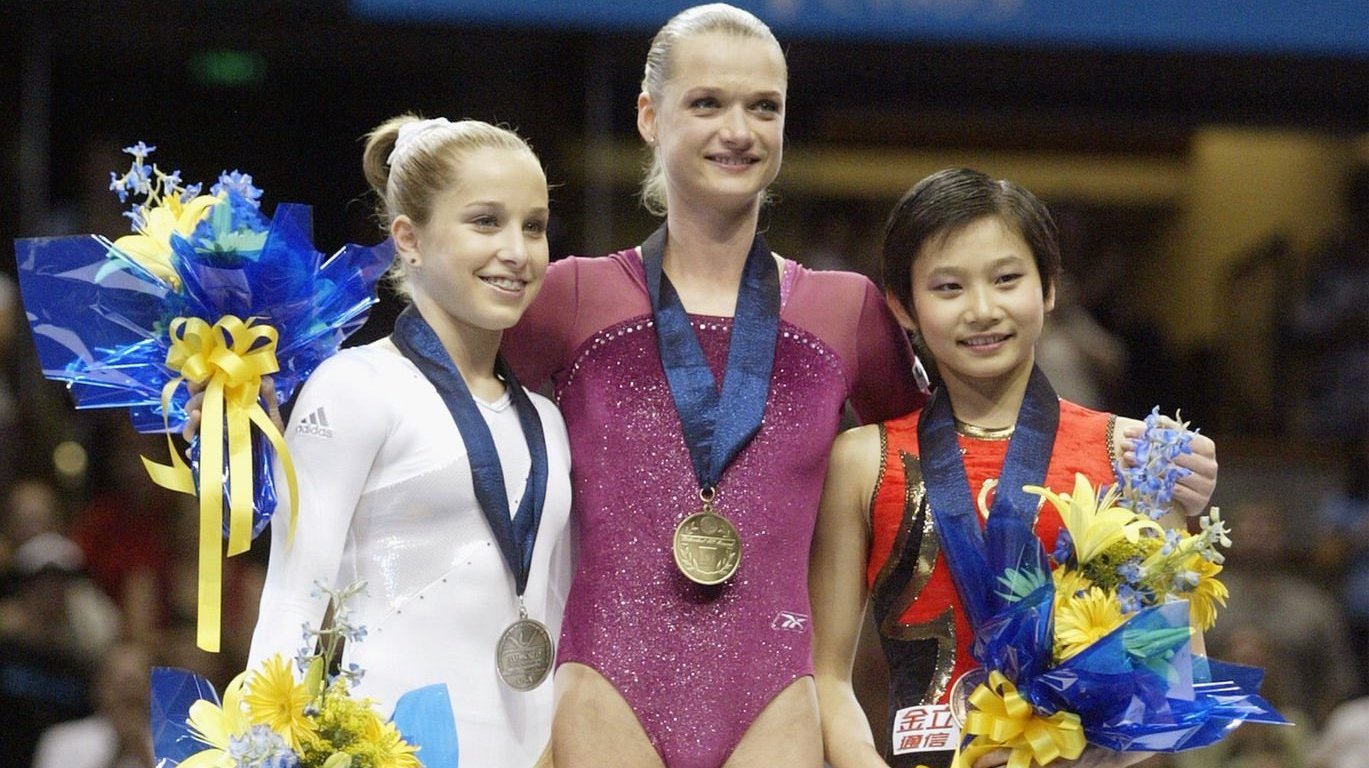
Svetlana Khorkina (2003 World Championships)
Bridget Sloan (2009 World Championships)
Gabby Douglas (2012 Olympics)
Of those five gymnasts, four of them finished their careers without ever winning an EF medal at the Olympic or World Championships. The lone exception was Svetlana Khorkina.
Whereas only 16% of instances were AA gold medalists, for the remaining 26 instances they were split evenly down the middle with 13 being silver medalists and another 13 being bronze medalists. In the end 16% were gold medalists, 42% silver, and 42% bronze.

This trend has occurred 31 times, but only amongst 27 different gymnasts as there were 4 gymnasts who have done it twice. Those four gymnasts were:
Lavinia Milosovici (1995 & 1996)
Svetlana Khorkina (2003 & 2004)
Zhang Nan (2003 & 2004)
Gabby Douglas (2012 & 2015)
No repeat gymnast has done it more than two times, but every repeat gymnast has done it once each at the Olympics and World Championships. Gabby Douglas was the only gymnast to do it in non-consecutive years.
On six occasions has the trend occurred multiple times in a single competition. Those competitions were:
1981 World Championships: Maria Filatova & Olga Bicherova
2003 World Championships: Svetlana Khorkina, Carly Patterson & Zhang Nan
2004 Olympics: Svetlana Khorkina & Zhang Nan
2007 World Championships: Jade Barbosa & Vanessa Ferrari
2012 Olympics: Gabby Douglas & Viktoria Komova
2015 World Championships: Gabby Douglas & Larisa Iordache
The 2003 World Championships was the only occasion in which this trend occurred with all three members of the AA podium. But the trend went further, none of them advanced to Event Finals on any event!
The 2003 AA podium of Khrokina, Patterson, and Zhang Nan were the first three ever to win an AA medal while simultaneously not appearing in Event Finals on any event. They were the first of 7 total gymnasts to do it. The other 4 were the following:
Jiang Yuyuan (2010 World Championships)
Larisa Iordache (2015 World Championships)
Tang Xijing (2019 World Championships)
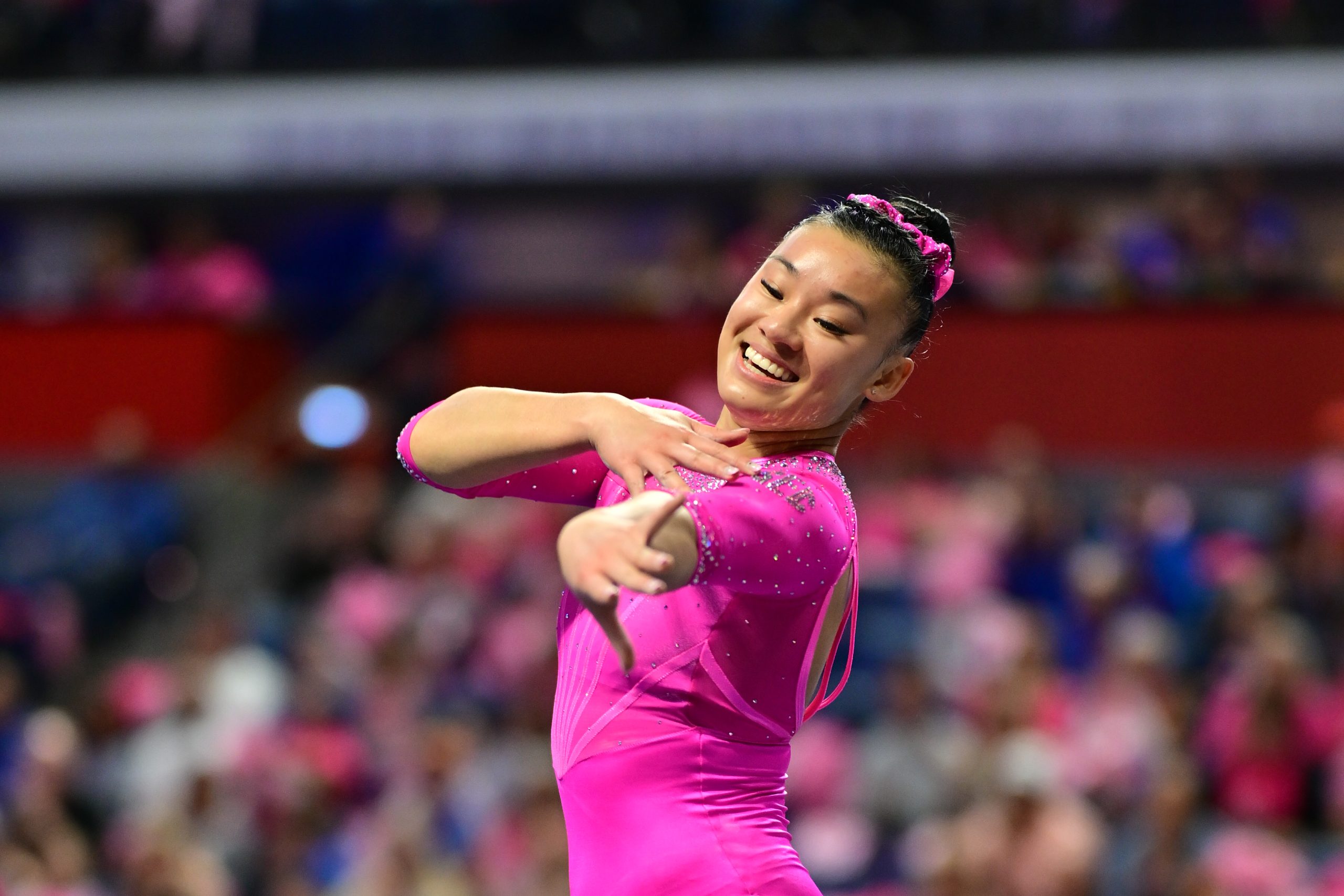
Leanne Wong (2025 World Championships)
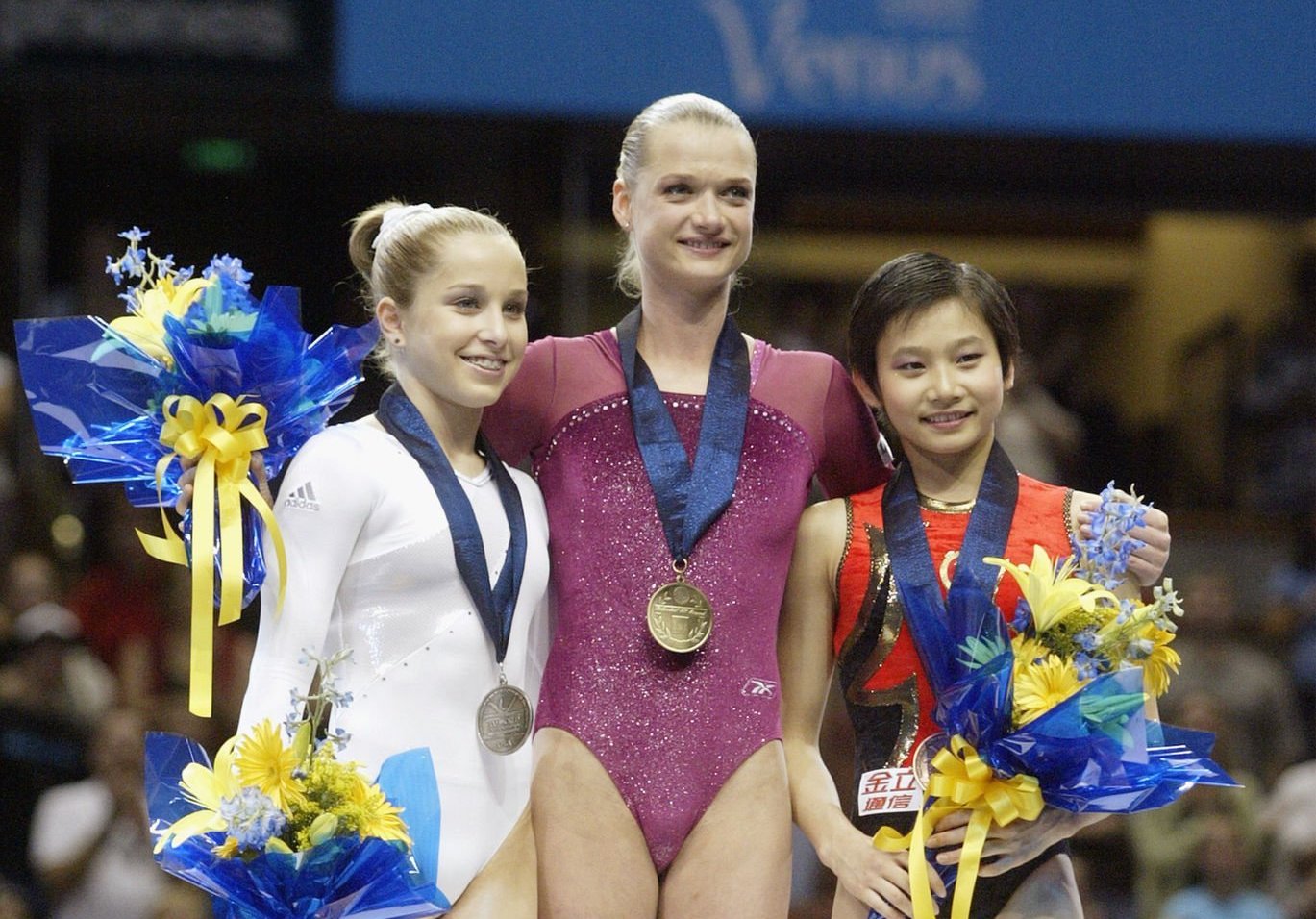
Carly Patterson famously won a medal on beam at the 2004 Olympics. It was the only time a gymnast won both an AA & EF medal in the 2-year stretch from 2003-2004.
There were no World Championships held in 1998 and no AA contested in 2002. This means that every competition in-between the 1997 World Championships and 2006 World Championships had an AA podium where this trend occurred.
Angelika Hellmann (East Germany) was the first gymnast to ever accomplish this trend, doing so at the 1974 World Championships. But Angelika is arguably the most unique of the 31 examples and needs her own separate subsection of unique facts.
Hellmann was the only example of these 31 instances to occur before the era where Event Finals was expanded to include 8 gymnasts. In Angelika Hellmann’s era only 6 gymnasts competed in EF. Despite that, Angelika was also the only one of these 31 instances where the gymnast competed in EF on all four events. She was the only one to do this while simultaneously being the only gymnast to compete under the more rigid requirement of a 6-person cutoff.
But the most baffling Hellmann stat of all is she competed at the 1974 World Championships during the iconic “double sweep” that has never occurred before or since. This was when two gymnasts (Ludmilla Turischeva & Olga Korbut) each won a medal on every event. Not only has this never occurred elsewhere, even a single sweep is so incredibly rare that Simone Biles is the only gymnast to do it since the 1980s and it has occurred only three times since the 1974 World Championships.
Angelika Hellmann is the unluckiest gymnast in the entire data based purely on what she had to compete against.
Whereas Hellmann’s success meant only 1 of 31 examples was from a gymnast who competed in EF on every event (3%). Another 7 of 31 instances were from a gymnast that didn’t compete in EF on any event at all (22.5%). In total, only 4% of all AA medalists since 1950 did not appear in Event Finals on any event, the most recent example of which occurred at the 2025 World Championships. But the trend has become more common in recent years and occurred with 12% of all AA medalists since the 2015 World Championships.
Not all of these 31 instances led to a gymnast walking away from the competition with only a single medal. In 18 of 31 instances the gymnast won a team medal (58%). But of the 13 remaining instances 6 were linked to post-Olympic World Championships where no team event was held.
The final percentage breakdown is 58% won a team medal, 23% did not win a team medal, and 19% competed in competitions where no team competition was held.
The gymnasts who lost out on both a team medal and an EF medal despite winning an AA medal were the following.
Svetlana Khorkina (2003)
Zhang Nan (2003 & 2004)
Vanessa Ferrari (2007)
Jade Barbosa (2007)
Larisa Iordache (2015)
Tang Xijing (2019)
At the 2015 World Championships Larisa Iordache infamously failed to qualify for the 2016 Olympics while simultaneously winning an AA medal. The primary goal of this project was to determine if Iordache-2015 was a unique stat line that has never occurred before or since.
The answer: Yes it was.
Iordache is one of only 7 examples (listed above) of an AA medalist winning no EF medals and no team medals in the same competition. But of the other six examples, they finished 4th, 4th, 4th, 5th, 6th, and 7th in the team competition whereas Iordache’s team finished 13th. This meant Larisa Iordahce-2015 is the only instance in all of women’s gymnastics history to have a combination of winning an AA medal, not winning an EF medal, and not advancing into team finals.
But it was even more extreme than that. Whereas Iordache was already the only gymnast ever to win an AA medal with neither an EF medal or an appearance in Team Finals to go along with it, even under more lenient benchmarks she still would be the only gymnast in history to have the combination of an AA medal, not having her team make the 12-team cutoff, and not appearing in event finals on any event.
The heartbreaking circumstances of 2015 were the result of the Olympic qualification rules not being able to account for a scenario so unusual, it has never occurred before or since. And the gymnast who had the combination of events creating this scenario had an even more extreme version of the combination than what would have been needed to qualify for the Olympics.
Link to the data this article was based on
 An Old School Gymnastics Blog
I love seeing the names from decades ago, but could you possibly make this email a bit shorter? Otherwise I will unsubscribe which would be a pity!
LikeLike
This is an *EXCELLENT* treatment of a trend that was identified and very much worth exploring, which you did.
LikeLike
I already commented on this, earlier today. But I was at a park composing on a phone and unable to figure out how to leave a name, etc. This is William Noel. I’ve commented a few times before on various of your blog entries.
Again, this was an incredible treatment. I haven’t yet read every word. But it is truly an exhaustive application of a question, an answer, and a theme. (Doing the same for the men could prove interesting, although a good bit more work, as they had 10 more World Championships and 11 more Olympics, compared to the women, where AA and individual medals were at stake.)
I should state that of the 5 you singled out who were World/Olympic Champs, I think Yurchenko was unique among those in that injury in the first EF prevented her from securing that or any other EF medals as she looks to me to have qualified to multiple of the EFs. It’s insane to think of her fame and overall success, while having only one World/Olympic (official, concerning the latter, as she does have ‘alternate’ Olympic success) individual medal, although she has medals at World Cups, etc. As for the other 4 in that initial list, I think they remained able-bodied after the AA and could have competed. Bicherova and Sloan both did on UB during those respective years (81 and 09). Not seeing any of the qualification info for the 03 Worlds on Gymn-Forum, I can’t make any comments on Khorkina. Douglas having done so in 2012 is something I remember noticing at the time with a fair degree of shock, although I never noticed that she repeated this in 2015.
Singling out Iordache the way you did is an act of at-least-borderline genius.
To say the least, it is a singling-out that took a TON of work and verification. It is also interesting that her 2015 Worlds phenomenon occurred on the 50 year anniversary of another interesting phenomenon for the woman who is the most decorated gymnast in the history of the sport – same-named Larisa Latynina.
(Yes, Simone Biles has more World Championship medals and more World and Olympic medals combined than Latynina, however Latynina’s Olympic record is still greater than Biles’s and likely always will be, and when you consider that in Latynina’s era, Worlds took place only 1/3 as often as they do in Biles’s era, do the reasonable adjustments and Latynina’s record speaks only that much more loudly, but this is a digression.)
Anyway, so Iordache’s last individual medal at a Worlds was 2015, and Latynina’s last individual medal (of which she won a whopping 38) at a Worlds/Olympics/Europeans was 50 years before in 1965. Where it seems obvious that Iordache could and should have had further World/Olympic success after 2015 (although she did pick up a few European individual medals later on), the same seems true for Latynina 50 years earlier, because at the 1965 Europeans, she won AA Silver, and a Bronze and 3 Silvers in EF, which is still an incredible showing, even if Caslavska had become the sport’s queen the year earlier. Seeing Latynina’s sharp dropoff in success the next year at the 1966 Worlds (11th in the AA and no individual medals), which essentially signaled the end of her career, starts to beg questions, and the coincidence of the two (Iordache and Latynina) should raise even more questions.
LikeLike
Sorry. Quick correction to my statement on how many more Worlds/Olympics’ data you’d have to work with to do the same for the men. While men gymnasts HAVE had 11 more Olympiads, than women, where they were awarded individual medals, only 6 of those 11 Olympiads saw BOTH an AA and some EFs. Nevertheless, yes, it would take more work to do the same for men than it would for the women.
LikeLike
I should also add, in terms of doing retrospectives with respect to 50-year cycles, the way I did with Latynina/Iordache, the 2003 Worlds being the first, as you put it, where none of the 3 AA medalists even competed in the EFs…well, this was on the 100 year anniversary of what is now regarded by the FIG as the first-ever World Championships – the 1903 games in Antwerp. Interestingly enough, these 2003 Worlds were held in another “A” city – Anaheim. Antwerp, Belgium -> Anaheim, California (USA). B to C.
If one were focusing only on what unfolded (or didn’t) at these 2003 Worlds in Anaheim, one could begin to question the legitimacy of this AA podium – after all, what worthy trio of AA champions wouldn’t even see a single qualification into EFs, from among 12 different opportunities? (3 gymnasts x 4 apparatuses = 12 opportunities) Do the math on this. Dividing 11 into 12, you get .917. So there is a 91.7% chance that there should be *at least* 1 AA medalist into the EFs, or an even greater chance than that, really, seeing as they are the 3 best, overall, and much more likely to make an EF than lower-ranked AA contenders. So, what happened in Anaheim was in the BOTTOM 8.3% of likelihood, or even lower than that, really, considering my “logic” herein. (At least this should be true for the women; men’s gymnastics is more of a specialist’s battle, so from my moderate familiarity, I would say that this would be more likely to happen (though still not very) on the men’s side than on the women’s side).
But, taking what happened with Iordache in 2015 and how it could seem to “illuminate” what happened with Latynina 50 years earlier, suppose what happened with the 2003 Worlds was somehow “engineered” to try to say something about the 1903 Worlds. In the context of a “deep-dive” study into the sport and all of the anniversary signifiers present in its history, with 50-year signifiers definitely registering, was this a way of saying that the AA results of the 1903 Worlds aren’t really legitimate? That would be a really, really audacious statement. However, the phenomenon of the mismatch between the 2003 Worlds AA and EFs in the women’s competition was, itself, a quite audacious manifestation and phenomenon.
LikeLike
Lastly, I should add that at the same time that the 2003 AA podium of Khorkina, Patterson, and Zhang is made to look ludicrous by the anteceding EFs, this was the same trio that made the AA podium the next year at the Olympics, albeit in a different order. So, with respect to the actual individuals of Patterson, Khorkina, and Zhang, their collective legitimacy was only further strengthened in Athens. But the previously-insinuated questions, nevertheless, remain.
LikeLike
P.S. Whereas Milosovici didn’t follow her AA medals up with any EF medals at either the 1995 Worlds or 1996 Olympics, she did win 1st on Floor at the 1996 Europeans (tied with eventual Olympic FX Champion Ukrainian Lilia Podkopayeva) and 3rd on Floor at the 1996 World Championships (tied with Ukrainian Lyubov Sheremeta), so she did still show her relevance in EFs during the latter part of her career. It just didn’t happen to manifest at the 1995 Worlds and 1996 Olympics like it did at the 1996 Europeans and 1996 Worlds.
Also, just like at the 1992 Olympics, Milosovici wore competitor number “292” on the 29th anniversary of fellow (ostensibly) ethnic Yugoslavian Marjana Bilic’s European AA conquest, she got 3rd in the Team Competition and 3rd in the AA, with no other medals, at the 1996 Olympics on the 33rd anniversary of Bilic’s said conquest. This could be said to echo her 3rd in the 1995 AA and 3rd in the 1996 AA with no succeeding EF medals at the biggest competitions those years.
Also, consider how the number “3” figures in for Miller at the 1996 Olympics – her medal results were, with respect to Olympic Order, 1, 0, 0, 0, 1, 0 as she got Gold in both the Team and Beam finals, with no other medals anywhere else. Here, you get a “triple zero” which could also be construed as a “triple circle”, pointing to Milosovici’s 3’s at the same competition. Their twinning from 1992 to 1996 is really the coincidence and phenomenon to behold – the only 2 female gymnasts to qualify to every EF in Barcelona 1992, Miller being WAAC in 1993 and 1994, whereas Milosovici joined the elite group of only Latynina and Caslavska to being World/Olympic Champ on every individual apparatus in 1993 and being the highest scorer, overall, at the 1994 Team Worlds, to the 1996 phenomenon I just articulated. Just…WOW!!!
Also, odd that there were so many Natalias affected here – Shaposhnikova, Yurchenko, Laschenova, Ziganshina. One could easily wonder if this theme is pointing to something. Back to Natalia Kot and Janina Skirlinska? The only other given names that come up more than once, among different individuals, are Maria and Viktoria – twice each. But Natalia FOUR different times?!?!?! That’s definitely attention-getting.
LikeLike
You could also add to this list Elena Shushunova – 1984 “Alternate Olympics” in Olomouc. AA Bronze (tied with Gnauck), but no EF medals – only apperance was FX where she was in last place (8th).
LikeLike